Here I will post some interesting math things. This is mostly to serve as my own notebook and thought archive, so there's a good chance a lot of the content is wrong. Don't expect much from here for the first few years, unfortunately. Moving here from AoPS: https://artofproblemsolving.com/community/c1216112_blogologolog, will be a while before I set up latex and mathjax properly.
Moduli space of circles
Through the Veronese map we have a map from all conics in \(\mathbb{P}^2\) to all hyperplanes in \(\mathbb{P}^5\). The subspace of all circles in this \(\mathbb{P}^5\) will be all hyperplanes through two fixed points. By intersection of these hyperplanes with another arbitrary hyperplane, we obtain a correspondence between all circles in \(\mathbb{P}^2\) to all hyperplanes in \(\mathbb{P}^3\), and then by taking projective duality, we can view a point in \(\mathbb{P}^3\) as a circle.
We can also explicitly construct this map by \(Ax^2 + Ay^2 + Dxz + Eyz + Fz^2 = 0 \to (A:D:E:F) \in \mathbb{P}^3\).
Note by the determinant condition on whether a conic is singular, we get a cubic surface of singular circles in \(\mathbb{P}^3\). Through a bit of work, it is possible to prove that this cubic surface is factorizable, specifically into a quadric \(\mathcal{Q}\) of all point circles and a plane \(\mathcal{P}\) of all lines union the line at infinity.
Furthermore, since this map is linear in coefficients, a circle \(c\) which can be written as the linear combination of two circles \(x,y\) after this map will go to a point on the line connecting the images of \(x,y\). Note that two circles are tangent if in the pencil of circles defined through their linear combinations, there exists exactly one point circle.
In other words, two circles are tangent if the line connecting them in \(\mathbb{P}^3\) is tangent to \(\mathcal{Q}\).
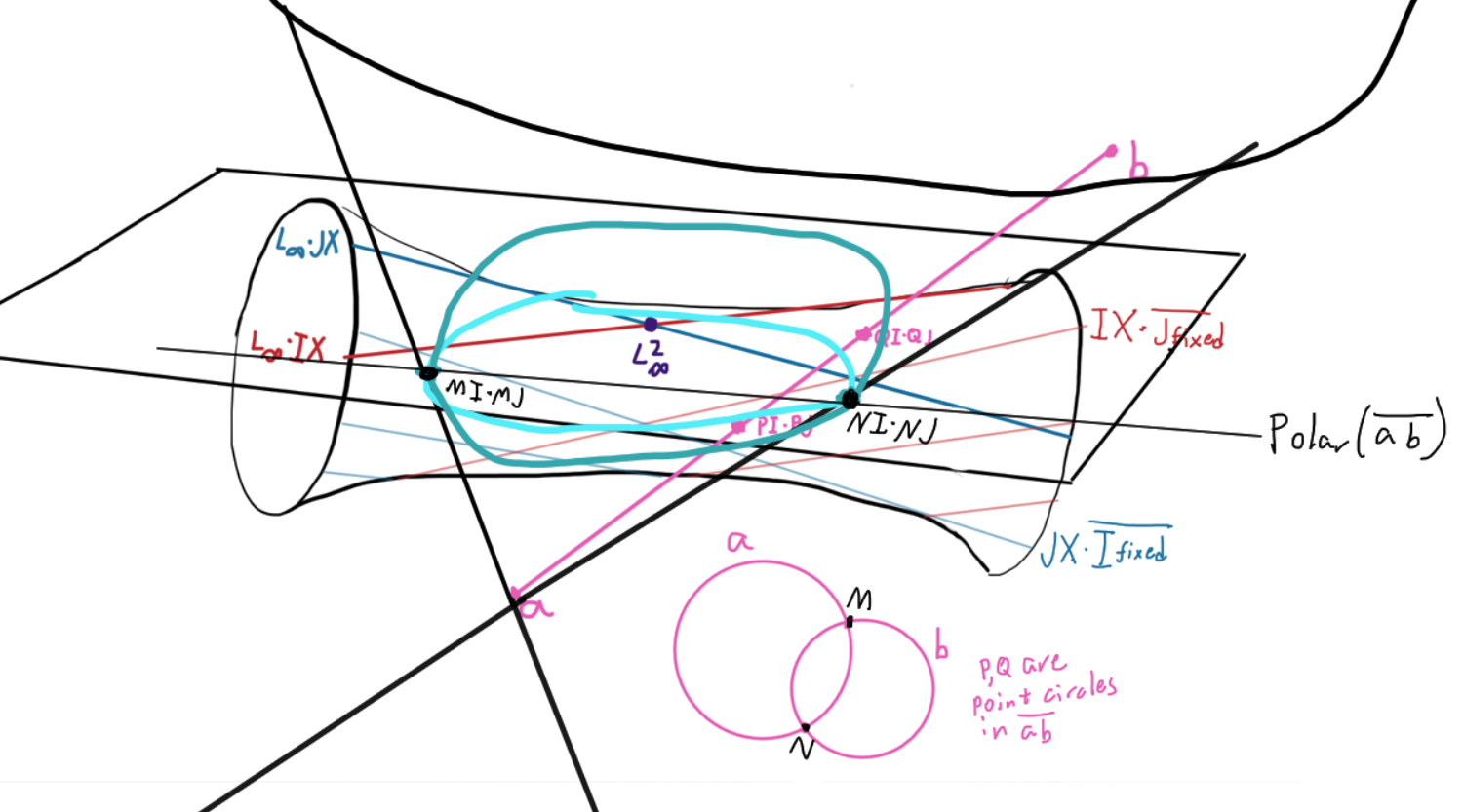
An elegant proof of Steiner's porism
The set of all circles tangent to two fixed circles \(a,b\) is the intersection of two cones \(\mathcal{C}_a, \mathcal{C}_b\) with vertices at \(a,b\), consisting of all points \(p\) such that \(pa, pb\) are both tangent to \(\mathcal{Q}\).
There is a well-known result in projective geometry where if two cones share a common inquadric, then their intersection (generically a quartic curve) is factorizable into two conics (prove this by taking homography of the inquadric to a sphere)
Thus the set of all \(p\) factors into two conics, for real circles, consisting of one conic corresponding to all circles either both externally or both internally tangent to \(a,b\), and the other conic corresponding to all circles externally tangent to \(a\) and internally tangent to \(b\), or vice-versa.
Now Steiner's porism constructs two circles \(B_1, B_2\), and considers a chain of tangent circles \(C_i\) internally tangent to \(B_1\) and externally tangent to \(B_2\), stating that if one such chain exists, then there are infinite chains. Through our map, the set of these circles gives a conic \(\mathcal{K}\) in \(\mathbb{P}^3\). We have \(C_i \in \mathcal{K}\), and since \(C_i\) is tangent to \(C_{i+1}\), \(\overline{C_i C_{i+1}}\) is tangent to \(\mathcal{Q}\).
Therefore by considering the cross-section on the plane containing \(\mathcal{K}\), we get a Poncelet system with \(\mathcal{K}\) as the circumconic and the plane's intersection with \(\mathcal{Q}\) as the inconic, and Steiner's porism really just follows from Poncelet's porism.
Moving circles
It is well-known that any morphism from \(\mathbb{P}^1 \to \mathbb{P}^n\) with degree \(d\) less than \(n\) is degenerate, since we are choosing n+1 sections of the sheaf \(\mathcal{O}(d)\) on the projective line, which is a module of rank \(d+1\), so \(d+1 < n+1\) implies a linear dependence among the sections.
Thus any degree-2 moving circle, will move along a conic C contained in some plane of \(\mathbb{P}^3\). This plane will intersect \(\mathcal{Q}\) at some conic D. Generally C and D will intersect at four points, implying a degree-2 moving circle will generically be a point circle exactly four times. However, when C and D are bitangent, then the moving circle is tangent to two fixed circles.
Counting the general number of tangents to a degree-n curve: through cursed moving points
This is a continuation of the first blog post and is slightly deranged.
Recall that a moving point in the projective plane can be given by a regular map from P1 into P2. A geometric condition (i.e. collinearity) can be given by a function in the function field of P2, which pulls back through some moving point, to a function on P1 with certain degree (defined as its number of zeroes).
This is a technique common in olympiad geometry, where degree+1 "cases" can be checked to prove the function on P1 is always zero.
For a degree-n smooth algebraic curve \(\mathcal{K}\), we can do the same thing.
However the annoying thing is due to Bezout's theorem, a degree-1 condition in P2 will give a degree-n condition on \(\mathcal{K}\) (since the zero set of the condition will intersect the curve n times). Now the pullback through a "moving point" (a regular map from K to P2) will give a rational function \(\varphi\) on the function field of K with degree \( nd \).
As an example, let P be a point in the plane and let's count the number of points A with the tangent at A passing through P. This tangent line can be given by the (n-1)th polar of A in K, which as a map from P2 into dual of P2 is a degree n-1 map. A line in P2 passing through a point in P2 is a degree 1 function. Therefore the function on \(\mathcal{K}\) corresponding to the condition has degree \(n(n-1)(1) \), so we are done.
This is all rigorizable with effective and principal divisors but whatever. oh and btw a linear system of a degree-2 divisor somehow characterizes all pairs of "involutions" on a curve but there's still a lot to figure out. (i don't actually know any intersection theory so I assume for smooth enough curves linear and rational equivalence are basically the same thing and rational equivalence of divisors is basically just two evaluations of the same moving point.)
A triangle is a very ugly cubic.
Many triangle geometry theorems are really just theorems about cubics.
Define the "second polar" as the first polar of the first polar, defined in the previous post. Then we have the following:
The first polar of a triangle wrt. a point P is the circumconic with perspector at P.
The second polar of triangle wrt. a point P is its trilinear polar.
These aren't hard to show geometrically, e.g. by cross-ratio properties. But Clairaut's theorem lets us swap the partial derivatives, getting the following property:
Any point Q on the circumconic with perspector at P has trilinear polar of Q passing through P.
This immediately proves how the trilinear polar of any point on the circumcircle passes through the symmedian point.
Counting the general number of tangents to a degree-n projective curve
Suppose you have a degree-n smooth algebraic curve \(\mathcal{K}\) and a sufficiently general point P in the complex projective plane. We will prove the following theorem in a very overkill way.
Theorem: There are generally (n)*(n-1) tangents to the curve which can be drawn through P.
The standard proof .
Let \(\frac{\partial K}{\partial x}, \frac{\partial K}{\partial y}, \frac{\partial K}{\partial z}\) be the three partial derivatives of \(\mathcal{K}\). Consider the first polar curve of P wrt. this algebraic curve, defined as \[P_x\frac{\partial K}{\partial x}+P_y\frac{\partial K}{\partial y}+P_z\frac{\partial K}{\partial z}=0\].
Since this curve is of degree (n-1) and intersections with it and the original curve correspond to tangent lines through P, we have n*(n-1) tangents by Bezout's theorem.
A proof with Riemann-Hurwitz
Define a rational map from the curve to the Riemann sphere via projection through P onto some unspecified line. Then, we will have each tangent (up to multiplicity) is actually a degree-2 ramification point of this map, so we can count it with Riemann-Hurwitz!
We have by Riemann-Hurwitz, where chi(K) is the Euler characteristic of our curve and e_P is the number of preimages of a point P: \[\chi(\mathcal{K})=N \cdot 2 - \sum_{P \in K} (e_P-1).\].
By the genus-degree formula and Euler characteristic formula, we will have
\[g(\mathcal{K}) = \frac{(N-1)(N-2)}{2} \implies \chi(\mathcal{K}) = 2-(N-1)(N-2) =N \cdot 2 - \sum_{P \in \mathcal{K}} e_P-1.\]
\[\sum_{P \in \mathcal{K}} e_P-1 = 2-(N-1)(N-2) -N \cdot 2 = N(N-1) .\]